Sense
Compatible tubes or sensors detect movement or agreed environmental conditions.

Smart Lighting / LumiSense
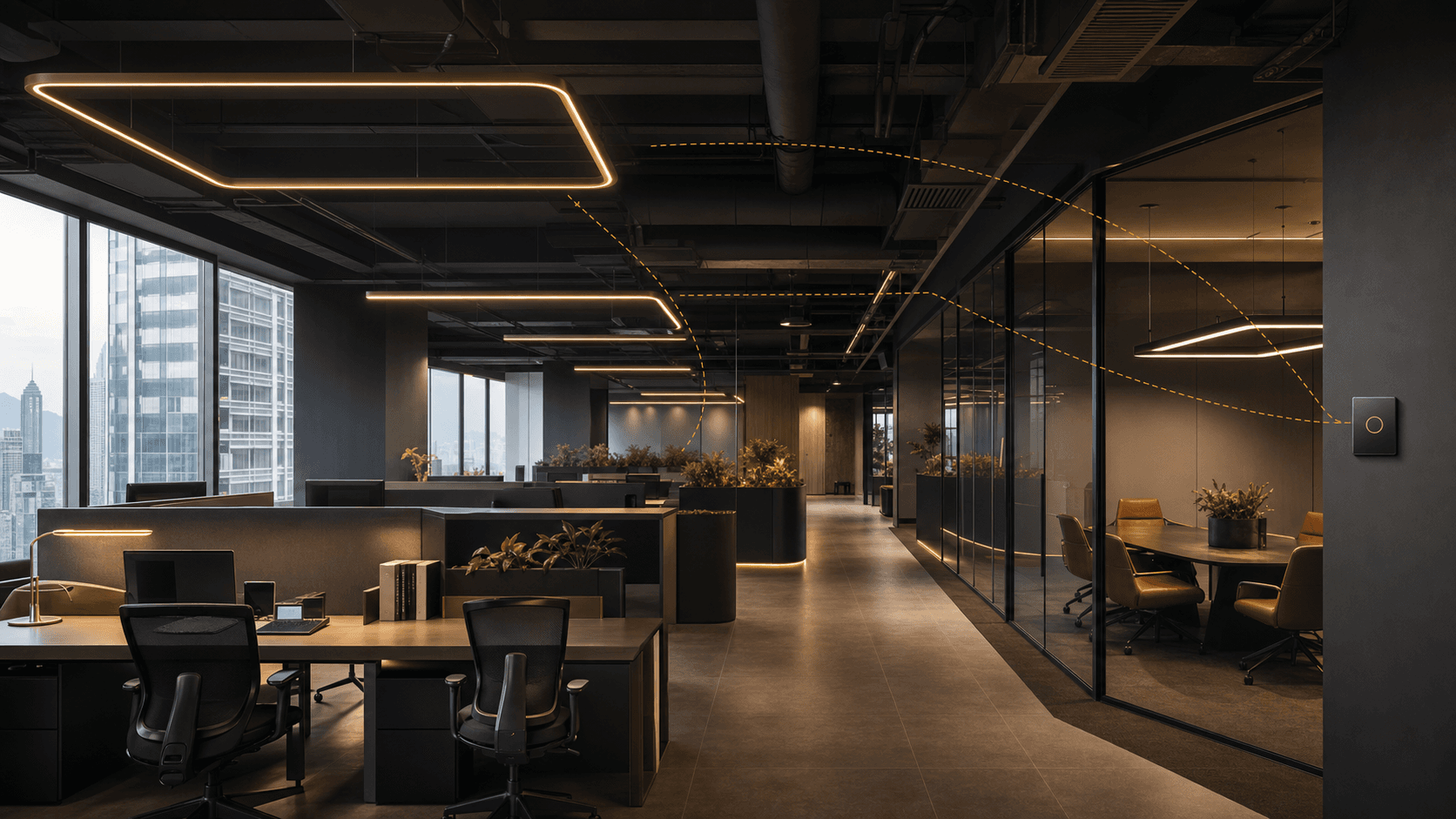
LumiSense combines C2ME control technology, compatible lighting, built-in sensing and local wireless control for offices, car parks, warehouses, hotels and restaurants.

Commercial lighting control
The system is planned around when light is required, which zones should respond together and how authorised users need to operate an existing or new commercial space.
Compatible tubes or sensors detect movement or agreed environmental conditions.
Lighting nodes exchange local control instructions so a defined area responds together.
Scenes, schedules, wall controls and app operation are configured to the approved scope.
Go-Between supports assessment, proposal development and installation coordination.
Operating logic
A person or vehicle is never shown as a signal transmitter. The sensing device detects movement and the lighting network carries the response.
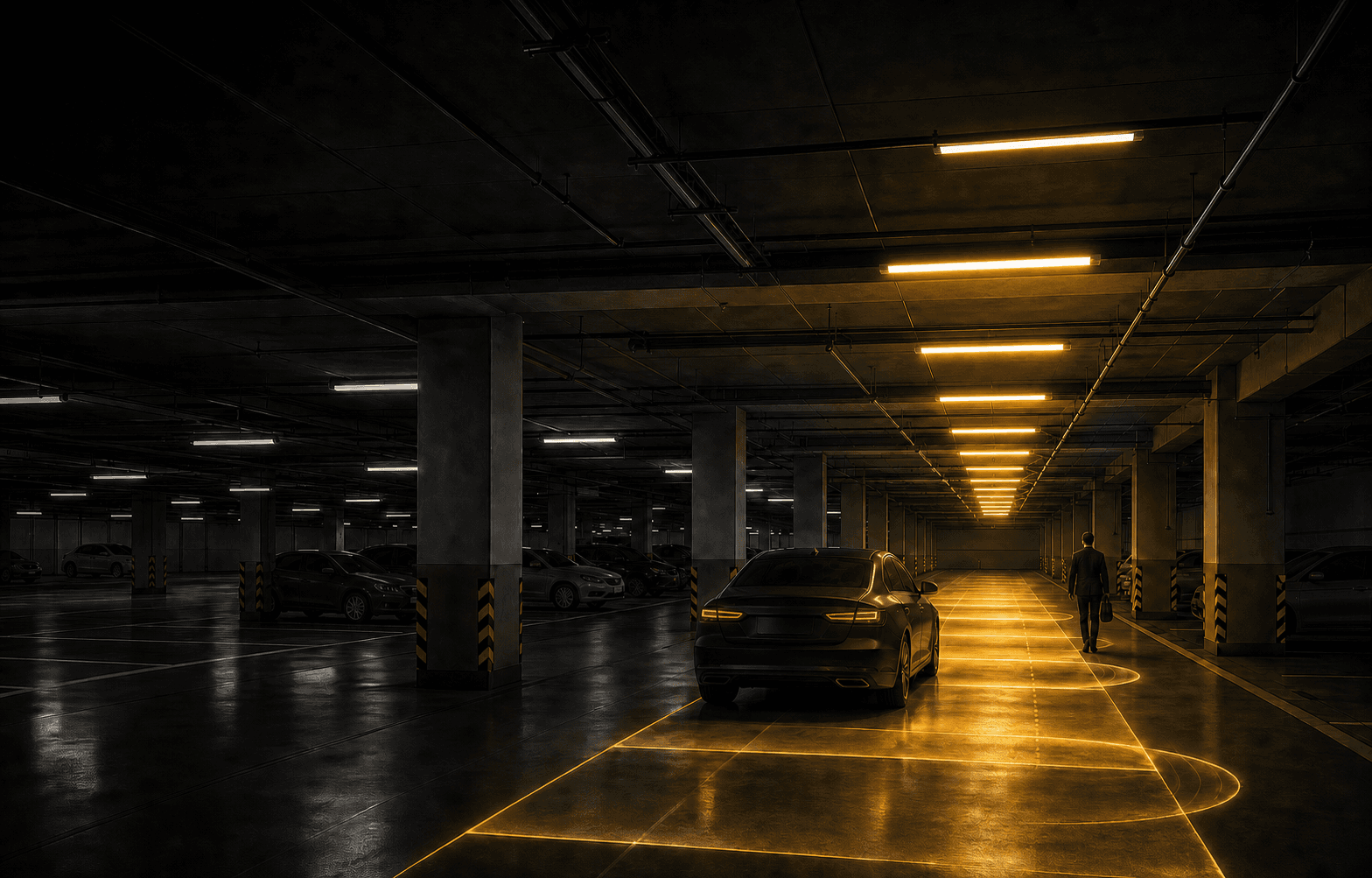
A person, vehicle or object enters a configured sensing zone.
Detection is made by the installed sensing equipment, not by the moving object.
The detected node sends a local C2ME control instruction to the agreed neighbouring zone.
The active range brightens with normal white light; outside the range remains at a configured low-brightness standby level.
System comparison
| Consideration | Traditional switched lighting | Typical wireless or bus control | C2ME direction |
|---|---|---|---|
| Control logic | Circuit-level switching | Often coordinated through a gateway or central controller | Local node-to-node control for configured functions |
| Signal cabling | No control network | May require control wiring or gateway planning | Wireless control can reduce additional signal cabling, subject to the approved design |
| Internet dependency | Not applicable | Varies by system | Core local functions can operate without external internet, according to supplier documentation |
| Changes to zones | Usually physical circuit changes | Depends on architecture | Software grouping can support layout changes within the commissioned scope |
Technical architecture
Direct connection, mesh networking and many-to-many communication are described in the supplier technical material.
Compatible controllers, sensors, panels and gateways can be combined around the operating brief.
Configured local lighting functions do not require continuous external internet access, according to supplier documentation.
99.99% stability, 3,600-node synchronised control and 1,200-node scene control are supplier-documented claims, not project guarantees.
The supplier documents a Sub-G extension with a 2 km line-of-sight range at 800-900 MHz. Actual range depends on the selected hardware, obstruction and site conditions.
Compatibility, radio coverage, response zones and control permissions are confirmed during design and testing.
Reference specification
IoT T8 figures below are based on the supplier technical presentation, page 32. Final model availability and the latest datasheet must be confirmed for each proposal.
| Item | Supplier-documented reference |
|---|---|
| Model | T058-FAC-L-4F-20-016-865 |
| Input | 100-240 V, 50-60 Hz |
| Power | 16 W |
| Length | 1,200 mm |
| Luminous flux | 2,100 lm |
| Colour temperature | 4,000 K / 6,500 K |
| Efficacy | 130 lm/W |
| CRI | 80 |
| Beam angle | 160° |
| Control | 100% / 10% step dim, motion detection and linked lighting |
0-10 V, single-colour, tunable-white and RGBW directions are listed in the supplier documentation.
Wall panels, dry-contact switches, daylight sensors and motion sensors can be considered.
Gateway and repeater requirements depend on remote access, schedule and coverage needs.
Commercial smart lighting applications
Movement-led zone brightening with a configured low-brightness standby level outside the active range.
Linked lighting for aisles, loading zones and circulation routes based on an agreed sensing plan.
Scenes, schedules and control interfaces for lobbies, public areas and hospitality spaces.
Operational scenes for different service periods and straightforward staff controls.
Scene control and compatible T5 or T8 control for classrooms and specialist rooms.
Zoning, meeting-room use, schedules and compatible daylight sensing for changing work patterns.
Illustrative planning model
This is an illustrative calculation, not a guaranteed project result. Actual power draw is not always linear with brightness. Occupancy, sensor settings, standby consumption, zoning, operating hours, tariff and maintenance conditions must be measured or confirmed for the site.
Delivery approach
Review existing lighting, circuits, operating hours, movement patterns, control needs and installation constraints.
Set out the proposed zones, sensing logic, products, controls, responsibilities and assumptions.
Where appropriate, test a representative area before wider installation and coordinate with the relevant project parties.
Confirm scenes, response zones and user controls, then document agreed handover and support.
Frequently asked questions
A commercial smart lighting management system coordinates compatible lights, sensors, zones, scenes and schedules around how a site operates. Go-Between reviews the existing lighting, movement patterns and control requirements before recommending a project scope.
LumiSense uses C2ME Bluetooth control technology described in the supplier documentation as patented in Singapore. Integrated sensors detect activity, then local lighting nodes coordinate configured brightness, scenes and schedules. Patent and technical details remain subject to the current supplier documents.
The system can be planned as an upgrade using existing lighting circuits and generally does not require new control-signal cabling. The existing power supply, wiring condition and safety requirements must still be checked for each site.
Potential applications include offices, car parks, warehouses, hotels, restaurants and schools. The sensing method, zones, schedules and compatible equipment must be planned for the actual operating pattern and site conditions.
According to the supplier technical documentation, configured core local lighting functions can operate without continuous external internet access. Remote access, gateway and network requirements depend on the selected project configuration.
Source material
The latest model datasheet, compatibility review and project-specific technical information are supplied during proposal development.
Go-Between Limited